In the world of digital imagery, every pixel tells a story. But have you ever wondered how these pixels come together to create stunning visuals? Enter bit planes—a powerful tool in image processing that plays a crucial role behind the scenes. Bit planes break down images into their most fundamental components, allowing for intricate manipulation and analysis.
As technology advances, understanding how we process images becomes vital for various applications—from medical imaging to computer vision. This blog post will take you on an exciting journey through the concept of bit planes and reveal how they transform image processing as we know it today. Buckle up as we explore this fascinating topic!
Understanding the Basics of Binary Numbers
Binary numbers form the foundation of digital computing and image processing. Unlike our familiar decimal system, which uses ten digits (0-9), binary relies solely on two: 0 and 1.
Each digit in a binary number represents a power of two. For example, the binary number 1011 translates to decimal as follows: \(1 \times 2^3\) plus \(0 \times 2^2\) plus \(1 \times 2^1\) plus \(1 \times 2^0\). This equals eight plus zero plus two plus one—resulting in eleven.
In image processing, these binary representations are crucial. Images are essentially arrays of pixels, each pixel can be represented by bits that denote color or intensity values. The ability to manipulate these bits allows for advanced techniques like compression and enhancement.
Understanding this fundamental concept opens doors to exploring how images are transformed into bit planes for further analysis and improvement.
Converting Images into Bit Planes
Transforming images into bit planes is a fascinating process. It begins with breaking down the image data into its binary components.
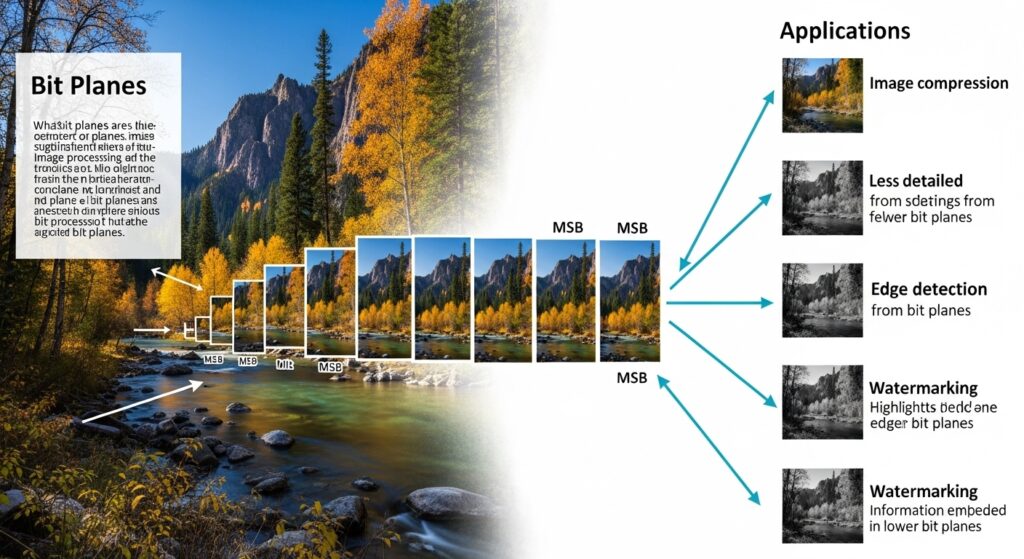
Each pixel in an image consists of multiple bits, typically 8 for grayscale or 24 for color. When you convert these pixels into bit planes, you’re isolating each bit layer that contributes to the overall picture.
For example, consider an 8-bit grayscale image. You’ll have eight distinct layers—each representing one bit from the pixel values ranging between 0 and 255.
These layers can be visualized independently, revealing how different bits influence brightness and contrast. This method allows for precise manipulation of images since you can adjust individual planes without affecting others.
The process enhances clarity when working on specific aspects of images during editing or analysis. By focusing on specific bits, artists and engineers can achieve remarkable effects in their projects.
Advantages of Using Bit Planes in Image Processing
Bit planes offer several advantages that enhance image processing techniques. By breaking down an image into its binary components, we can analyze individual layers of information more effectively.
One significant benefit is improved data compression. Since bit planes represent the intensity levels in a simplified manner, they allow for more efficient storage and transmission of images.
Additionally, using bit planes enhances noise reduction. Isolating specific bits helps focus on essential features while minimizing unwanted artifacts. This leads to clearer images with enhanced detail.
Another advantage is flexibility in manipulation. Each bit plane can be adjusted independently, enabling targeted operations such as filtering or enhancement without impacting the entire image.
Bit planes support various applications from medical imaging to remote sensing by providing precise control over how images are processed and analyzed. This versatility opens doors for innovative developments across multiple fields.
Real-Life Applications of Bit Planes in Image Processing
Bit planes find diverse applications across various industries, revolutionizing how we process images. In medical imaging, they enhance the clarity of scans like MRIs and CTs. By isolating specific bit planes, radiologists can detect minute abnormalities with greater precision.
In satellite imagery, bit planes improve data analysis for environmental monitoring. Researchers use them to distinguish land features from shadows or clouds, enabling better decision-making regarding urban planning and agriculture.
Security systems also benefit from this technology. Bit plane decomposition helps in facial recognition by focusing on essential features while filtering out noise. This leads to faster verification times and improved accuracy.
Digital communication leverages bit planes as well. Compression algorithms utilize them to reduce file sizes without significant quality loss, making it easier to transmit high-resolution images over limited bandwidth networks.
Challenges and Limitations of Bit Planes
While bit planes offer exciting opportunities in image processing, they come with challenges that can’t be overlooked. For starters, the complexity of managing multiple layers can lead to increased computational costs. This is especially true for high-resolution images where the number of bit planes skyrockets.
Another limitation lies in data redundancy. As images are broken down into individual bits, some information may become less accessible or lost entirely, complicating tasks like reconstruction or analysis.
Additionally, not all algorithms efficiently utilize bit plane representation. This can result in subpar performance when applying standard techniques optimized for traditional image formats.
There’s a steep learning curve associated with mastering bit plane manipulation. Professionals must invest time and resources to understand the nuances involved fully. These factors highlight that while beneficial, working with bit planes requires careful consideration and expertise.
Future Possibilities for Bit Planes in Image Processing
As technology advances, the potential for bit planes in image processing continues to expand. One exciting area is the integration with artificial intelligence and machine learning. By harnessing these technologies, we can enhance how images are analyzed and interpreted.
Imagine real-time applications where bit planes dynamically adjust based on user interaction or environmental changes. This could revolutionize fields like autonomous vehicles, where rapid image interpretation is crucial for navigation.
Moreover, advancements in hardware may lead to faster processing times. With more efficient algorithms, extracting information from bit planes could become seamless and instantaneous.
We might also see improved compression techniques that rely on bit plane decomposition. This would allow higher quality images at lower file sizes—a game changer for storage solutions.
The intersection of augmented reality and bit planes holds promise too. Enhanced visuals could create immersive experiences by layering digital elements over our physical world using sophisticated image processing methods.
Conclusion
Bit planes represent a fascinating aspect of image processing, offering unique insights into how images can be represented and manipulated. By breaking down digital images into their binary components, these layers provide a simpler way to analyze and modify visual data.
Understanding the fundamentals of bit planes opens avenues for more efficient image analysis. It allows easier access to specific details within an image while preserving essential information. This breakdown proves especially useful in various fields like medical imaging, remote sensing, and even artificial intelligence.
The practical applications are vast. From enhancing low-light photographs to improving facial recognition systems, bit planes help improve performance across multiple domains. Despite some challenges—such as increased complexity during conversion or handling large datasets—the benefits often outweigh the drawbacks.
Looking ahead, there is significant potential for innovation using bit planes in advanced imaging techniques or real-time video processing.
As technology continues to evolve, so too will our understanding and utilization of this powerful tool in digital imagery.
Exploring the world of bit planes not only deepens our comprehension of images but also enhances our ability to innovate solutions tailored for today’s technological needs. The future may hold even more exciting developments that harness the power of these layers in profound ways.